HELLEBRAND TECHNOLOGIES
Your operation.
Reimagined.
Software, AI and automation for the work your business depends on.
Your best people.
Doing work that
deserves them.
You know the friction. The update someone has to chase. The same information entered twice. The decision waiting on a detail buried in another system.
Capable people make it work. They remember the exceptions, bridge the gaps and keep the day moving. But every workaround takes attention away from the work you hired them to do.
We build software around those moments. Give the process a clear path. Keep the context with the work. Put human attention where it makes a difference.
See that thinking in practiceBetter work.
Built around you.
Automation starts with understanding the job. We work with your people to design the process, build the software and improve it through real use.
- 01
Understand the work.
Follow a real task with your team. Find the repeated steps, disconnected tools and decisions that need human judgment.
A clear problem to solve - 02
Design the better path.
Map what should happen, who owns each step and how information moves. Plan for exceptions as well as the everyday flow.
A workflow built around your people - 03
Build. Connect. Test.
Turn that plan into working software. Connect the systems, automate the repeatable work and test it with the people who use it.
Working software, tested against real tasks - 04
Learn from real use.
Put the system to work. Watch where it helps and where friction remains, then bring that learning into the next improvement.
A better operation, with room to evolve
Less chasing the work. More moving it forward.
Know the work.
Then build
for it.
Research automation. Background screening. Messaging and ticketing. Different kinds of work, with a shared need: clear ownership, information that stays connected and a next step people can see.
Vantis
Move the research.
Keep the evidence.
A result is only as useful as the work behind it.
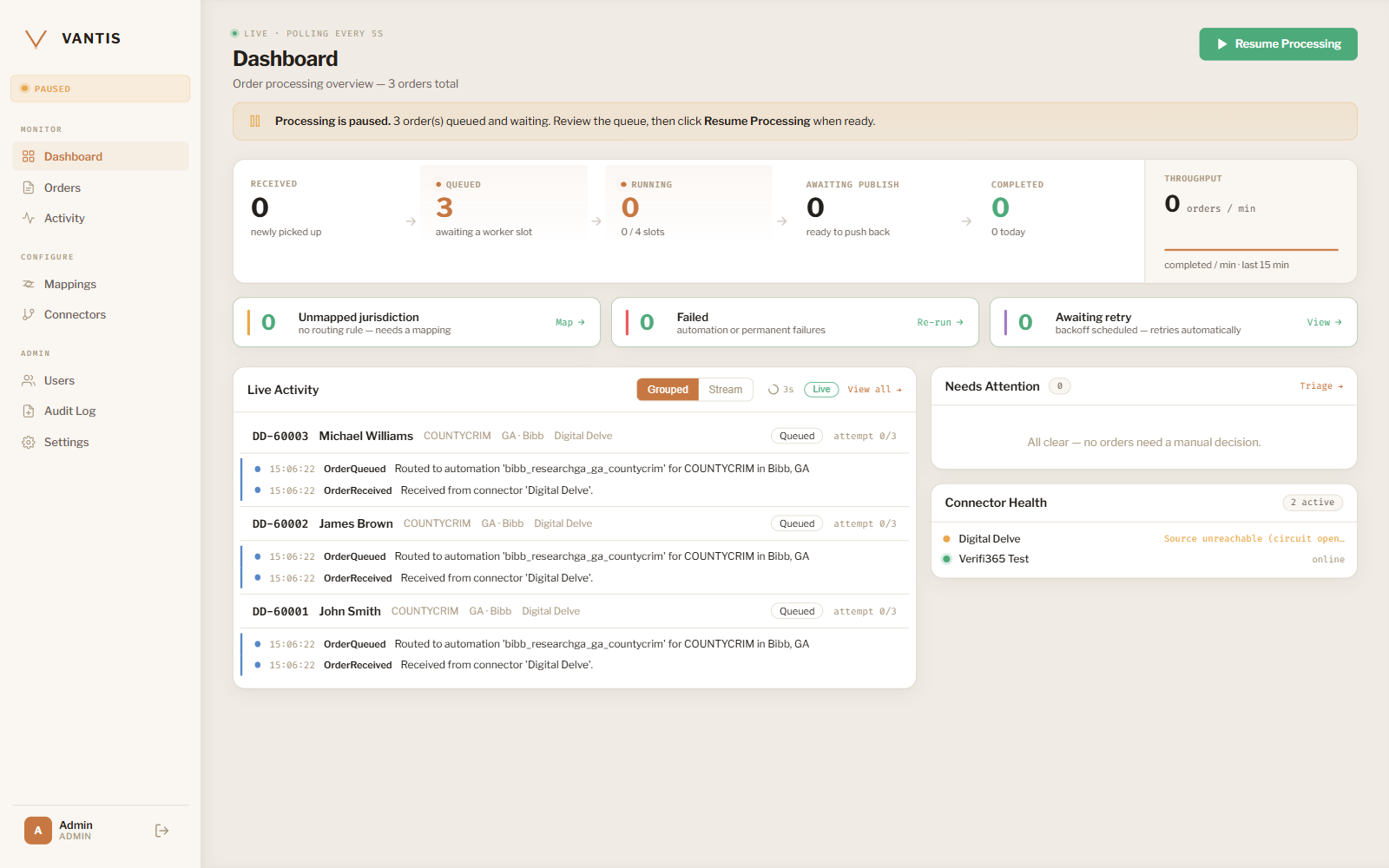
Research takes more than finding an answer. Vantis automates court research and other research workflows, connecting incoming orders, searches and source evidence in one reviewable operation. Your team can follow the work and see where human attention is needed.
Talk about Vantis01
Put the work in motion.
Route incoming orders to the appropriate research automation. Keep active runs, waiting work and interruptions visible, so operators can direct their attention without opening every search to discover its status.
02
Keep the evidence close.
A finding should not arrive as an isolated answer. Keep the result beside its source evidence, giving the reviewer the context to examine what was found before it moves downstream.
03
Make exceptions visible.
Surface failed or incomplete searches for human attention. Give the team a clear view of what stopped and what needs review, so they can decide how to move the research forward.
Order intake → Research → Source evidence → Operator review
Verifi365
One operation.
From order to outcome.
The handoff should carry the whole story.
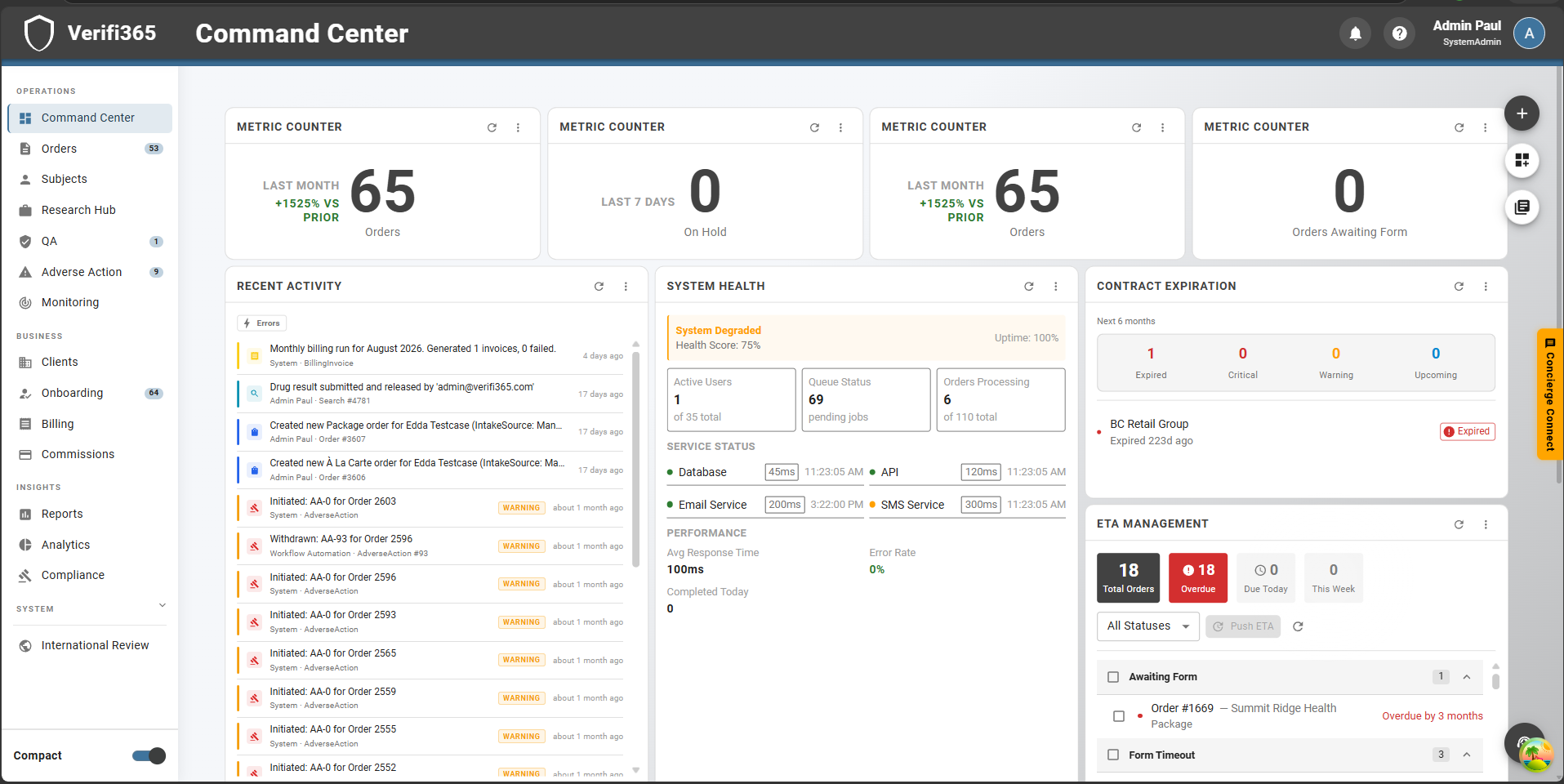
A screening order brings several searches, people and decisions together. Verifi365 connects intake, configurable workflows, search coordination, quality review and reporting, with communication alongside the order so the team can see what it needs next.
Talk about Verifi36501
Shape the workflow.
Define how orders and searches move, including the actions, handoffs and review points along the way. Give the process a structure the team can follow as the work progresses.
02
Connect the operation.
Bring orders, forms, client communication and research together. The next person gets the working context instead of having to reconstruct the order across inboxes and separate tools.
03
See the whole story.
Look beyond a single order to the health of the queue. See where work is moving, where it is waiting and which recurring patterns deserve a change in the process.
Intake → Search coordination → Review → Reporting
Relay
A message comes in.
Own the next step.
The conversation should move the work forward.
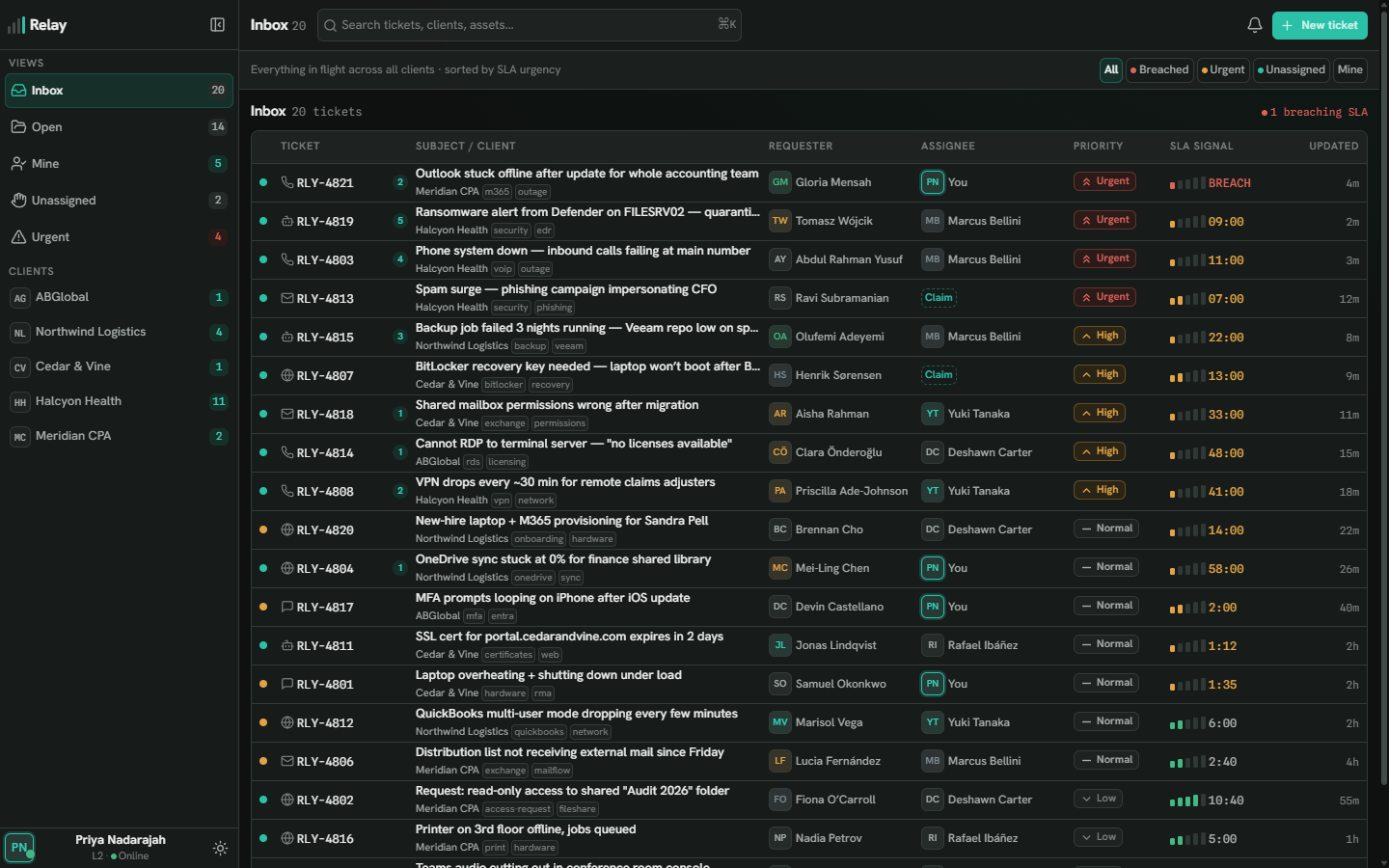
A message needs a response. A request needs someone to see it through. Relay brings messaging and ticketing together, keeping conversations, priorities and ownership connected so teams can coordinate the work and follow through.
Talk about Relay01
Give requests a home.
Organize incoming requests in a ticket queue with clear priorities and ownership. Help the team see what needs attention and who is responsible for moving it forward.
02
Keep the conversation connected.
Keep messages and ticket history close to the work. Team members can see what has already been discussed and continue the conversation without asking someone to explain it all again.
03
Close the loop.
Make progress visible to the people waiting on a response or resolution. Keep useful guidance in a shared knowledge base, giving the team somewhere to begin when a familiar question returns.
Conversation → Ticket coordination → Follow-through
Your next problem.
Our kind of work.
Have a process to improve or a product to bring to life? We build custom software, automate repetitive work and connect the systems your business relies on.
Close to the problem.
Closer to the people.
- 01
Understand the work.
Walk through a real example with the people doing the job. Follow the information, the handoffs and the exceptions. Find the friction underneath the request for a new feature.
- 02
Make the path clear.
Define a useful first outcome, the constraints and what can wait. Make the tradeoffs visible before they become expensive decisions inside the build.
- 03
Build with you.
Put working software in front of the people who will use it. Test the everyday path and the awkward cases. Use what we learn to shape the next iteration.
- 04
Keep it moving.
Work through ownership, monitoring, handoff and future changes. Launch is a milestone in the life of the system. The operating plan needs to account for what comes next.
What happens when a connected system stops responding? Who sees the problem? How does the work recover? We bring those questions into the design, alongside the everyday path through the system.
Who can see this information? Who can change it? Which actions need review? Data boundaries, permissions and human judgment shape the system from the beginning.
Good software starts
with listening.
Hellebrand Technologies is an independent software and technology company based in Ocala, Florida, led by founder Paul Hellebrand.
We work where software meets real responsibility: research that needs evidence, screening orders that need coordination and conversations and requests that need follow-through. Our products grow from those details. So does our approach to your business.
We believe the people building a system should understand the work it carries. That means asking direct questions, explaining the tradeoffs and caring about how the software behaves on an ordinary working day. The details are where confidence is earned.
Good questions.
Straight answers.
Choosing who builds your software is a consequential decision. Here is how we think about the work.
Do we need one of your products, or something built for us?
Start with the work you need to improve. Vantis automates research workflows, including court research. Verifi365 coordinates background screening. Relay connects messaging and ticketing. If your needs sit elsewhere, or span several systems, we can explore a custom application or integration. The first conversation is about fit: the people, process and constraints that should shape the choice.
Can you work with the systems we already use?
Systems integration is part of our work. We begin by understanding where your information lives, how the existing tools exchange it and which permissions or vendor limitations apply. That tells us what can be connected, what needs to change and where a manual review step still belongs.
Where does AI help, and where do people stay involved?
We look for a defined task before choosing the technology: extracting information from documents, handling repetitive steps or helping people find useful context. We also work through uncertain inputs, failure cases and review points. Where human judgment is needed, the system should give people the information and control to make the decision.
What should we bring to the first conversation?
An example of the process that is getting in the way is enough. Tell us who does the work, which tools they use, where it slows down and what a better day would look like. If you have a deadline, budget range or non-negotiable constraint, include it. You do not need a finished specification.
How do you approach scope, timing and cost?
Those depend on the work, the integrations and the constraints. We start by defining a useful first outcome and the assumptions behind it, then work through scope and tradeoffs with you. That gives the conversation about timing and cost something concrete to rest on.
What happens after launch?
The operating plan belongs in the project conversation from the start: who owns the system, how issues are found, what a handoff requires and how future changes will be handled. Support and ongoing development should be scoped around the needs of the engagement.
What should
work better?
Tell us about the process your team works around every day. The handoff that takes too long. The product you know should exist. We’ll start with the work and explore where we can help.
You do not need a finished brief. A clear example is a good beginning.
info@hellebrandtech.com